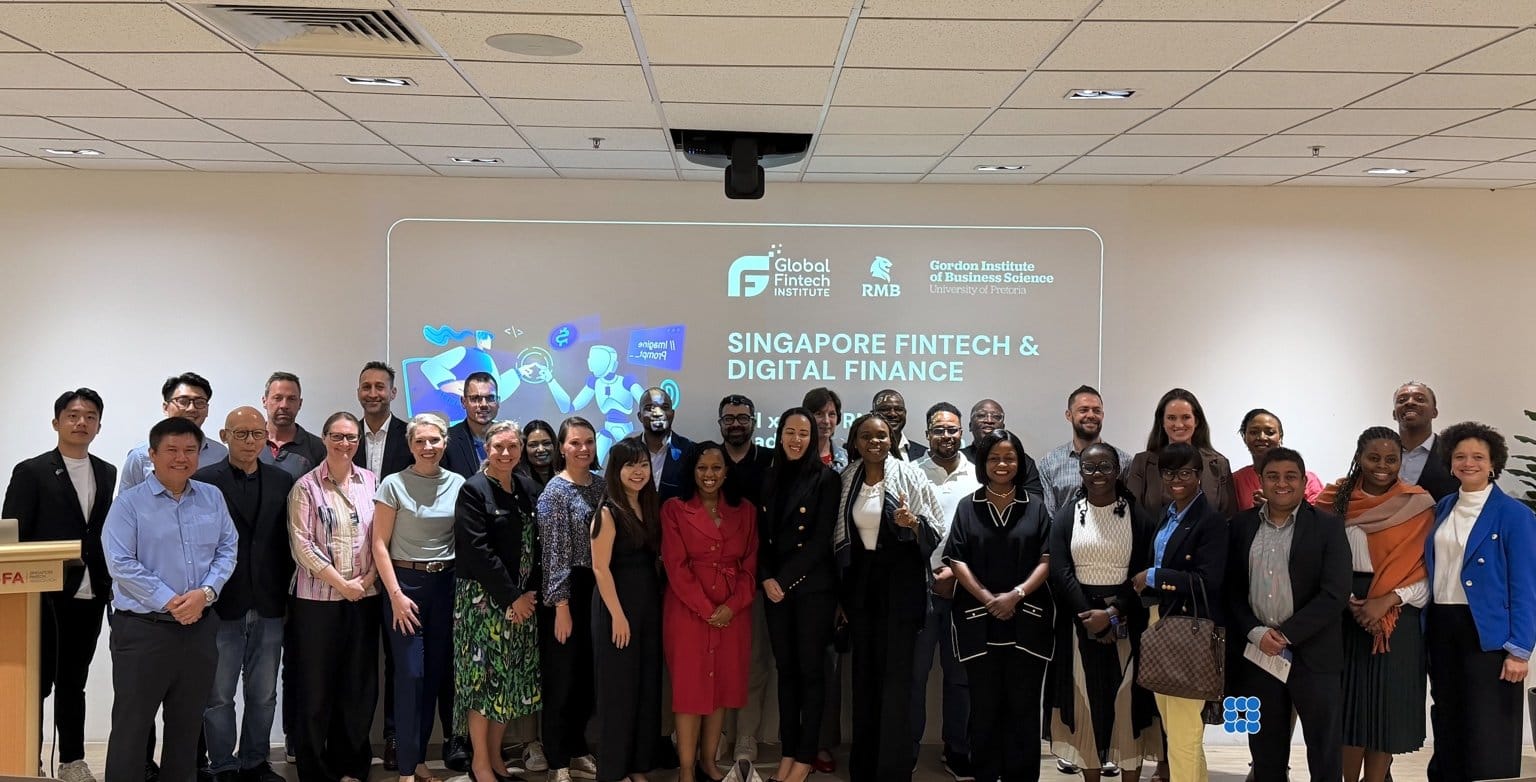
The Global Fintech Institute welcomed a delegation of senior executives from Rand Merchant Bank to 80RR FinTech Hub, Singapore on 8 July 2026, as part of the GIBS RMB 80 Degrees Leadership Immersion, a leadership development programme run with the Gordon Institute of Business Science, University of Pretoria. The session was day one of the delegation's Singapore learning journey, following briefings from the South African High Commission earlier that morning.
The delegation of 40 leaders spans group finance, macroeconomic research, corporate and investment banking, private equity, securities services, and markets technology across South Africa, Nigeria, and India. Chief Strategy Officer Hui Yi opened with an introduction to the Institute's work across certification, research, and ecosystem development, including the Chartered Fintech Associate (CFtA) and Chartered Fintech Professional (CFtP) pathways and the FLEX International Hub.
Tat Yeen Yap, GFI Chartered Industry Fellow, examined how digital trade finance is rebuilding trust in an industry still carrying the lessons of the duplicate-financing frauds that pushed several global banks out of commodity trade finance. Singapore was the second country in the world, after Bahrain, to adopt the UNCITRAL Model Law on Electronic Transferable Records through its 2021 Electronic Transactions Act amendment, and nine of the world's ten largest ocean carriers have committed to issuing 100 percent electronic bills of lading by 2030, a transition the industry estimates will save USD 6.5 billion in direct costs and enable USD 30 to 40 billion in additional annual trade, supported by frameworks such as IMDA's TradeTrust.
Lee Chong Han, Chief Executive Officer of SenSen and GFI Chartered Industry Fellow, took the delegation through payments in an AI-evolving world. The economics are stark: the World Bank puts the average cost of sending USD 200 across borders at above 6 percent, more than double the UN Sustainable Development Goal target of 3 percent, while stablecoin rails settle equivalent transfers for under one cent. With agentic AI entering checkout flows at major platforms, he argued that the question for banks is no longer whether these rails matter but how to operationalise them within regulatory guardrails.
Mike Chiam closed with Singapore's regulatory journey: a regulator that acts as both chief innovation promoter and enforcer, a sandbox that preceded the rulebook, and an expanding dispute-resolution toolkit for digital assets, from freezing orders over wallets to the Financial Services and Markets Act.
The afternoon ended with networking between the delegation, speakers, and the GFI team, and a gesture the Institute will remember: a handmade gift in original shweshwe, South Africa's iconic printed cotton, made from South African-sourced fabrics and lined with recovered plastic. The Institute thanks Rand Merchant Bank for the gift and looks forward to deepening its engagement with African financial institutions through its certification programmes and research platforms.