
[Singapore, 6 October 2025]

📺 This panel was part of the Digital Assets Summit 2025 mainstage held on 30th September 2025 at CHJIMES Hall, where leading voices in Web3, tokenization, and finance gathered to discuss how institutions can attract, train, and retain future-ready professionals.
Event Overview
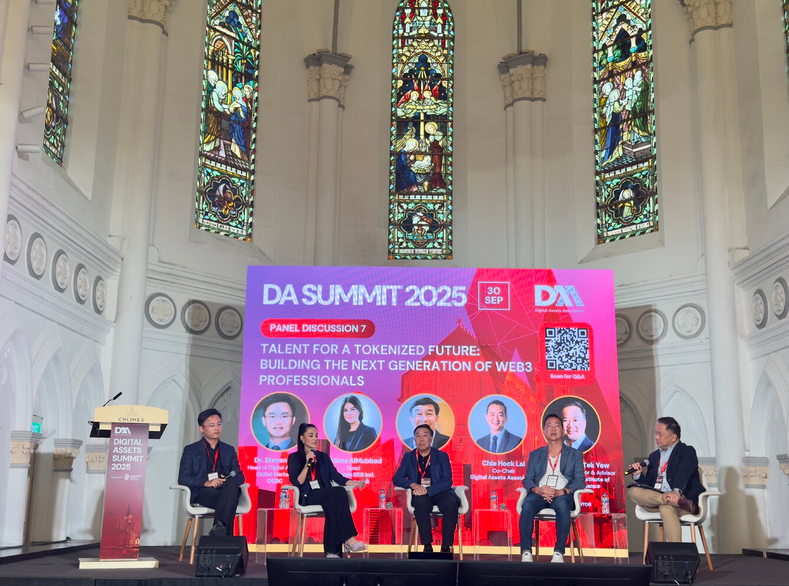
As the digital asset ecosystem matures, demand for Web3-ready professionals is outpacing supply — and the skillsets required are no longer siloed in tech or finance. In this forward-looking panel, speakers from academia, fintech, and global institutions unpacked a core question:
What does it take to build a generation of professionals who are technically fluent, financially literate, and ethically grounded?
The conversation centered on bridging the academia–industry gap, embedding ethics into Web3 education, and defining the future of professional pathways in tokenized finance.
Speaker Highlights: Prof David Lee, Global Fintech Institute

"David, from the university side, what skills really define a ‘Web3-ready professional’ today?”
“At the Global FinTech Institute, we define a Web3-ready professional as someone competent in three essential domains: technology, finance, and governance. Being technologically competent, means understanding smart contracts, token standards, interoperability, and the underlying infrastructure of decentralized networks. Someone financially competet would be able to use these tools to create viable applications—whether in DeFi protocols, the tokenization of real-world assets, or sustainable financing models. Finally, competence in governance enables professionals to navigate global regulatory regimes—from MAS’s Project Guardian in Singapore to Europe’s MiCA framework—while upholding the principles of ethics, transparency, and digital trust.
This integrated capability is the foundation of the Chartered FinTech Professional (CFtP®) program, where we equip talent not only to understand blockchain or AI in isolation but to apply them systemically across financial markets and regulatory environments. In short, a Web3-ready professional must be technically fluent, financially literate, and ethically grounded.”
“Are universities adapting fast enough to keep pace with the speed of industry change?”
“Universities are making important strides, but the reality is that industry moves at what we often call ‘Web3 speed’—measured in months, not years. Innovations such as DeFi powered by AI agents or next-generation payment rails emerge faster than most academic cycles can adapt. This is why GFI created the Chartered FinTech Professional (CFtP®) as a bridge between academia and industry.
The CFtP integrates rigorous theory with real-world applications: industry-led case studies, regulatory sandboxes, and partnerships with organizations such as MAS, IFC, and UNDP through initiatives like the SME Financial Empowerment Program. This ensures learners are grounded in strong academic principles but also exposed to the dynamism of industry innovation. The most successful models are those where academia, regulators, and industry leaders co-design curricula together, and the CFtP® institutionalizes precisely that collaborative model.”
“How do you balance giving students solid theory while still making them job-ready?”
“At GFI we take what we call a T-shaped approach. Depth comes from theory—monetary economics, cryptography, game theory, and financial management—so that professionals understand the ‘why’ behind financial technologies. Breadth comes from practice: applied labs where candidates test tokenization models, simulate central bank digital currencies, or design AI-driven compliance tools.
In the CFtP® pathway, candidates are required not only to demonstrate knowledge through rigorous examinations, but also to complete projects and problem-solving exercises grounded in industry reality. For example, a candidate might study the theory of governance in decentralized systems, then immediately apply it by designing a DAO framework or compliance solution. That balance ensures our graduates are not only job-ready for today’s demands, but resilient and adaptable to tomorrow’s industry shifts.”
“Web3 is often described as the ‘Wild West’ of finance. How do you ensure future professionals uphold ethics and trust in such a fast-moving space?”
“At the Global FinTech Institute, we believe that the future of Web3 will be defined as much by trust and governance as by technology itself. This is why the Chartered FinTech Professional program places ethics at its very core. Every CFtP® candidate is trained not only in technical and financial competencies, but also in professional conduct, governance, and the responsible use of technology.
Our approach is global by design: we embed comparative perspectives on regulatory frameworks—from MiCA in Europe to MAS’s sandbox approach in Singapore—while aligning with universal principles of integrity, accountability, and transparency. The expectation is clear: CFtP charterholders commit to a code of ethics that governs their professional behavior, much like lawyers or accountants.
The result is a new class of professionals who are not only fluent in blockchain, AI, and DeFi, but who can be trusted by regulators, employers, and the public to act responsibly. In an industry often described as the ‘Wild West,’ our role is to cultivate sheriffs—leaders who uphold standards and protect the credibility of the ecosystem.”
Notable Quotes 📌
“A Web3-ready professional must be technically fluent, financially literate, and ethically grounded.”
“CFtP® bridges the gap between academia and industry — not just teaching theory, but applying it systemically.”
“We need professionals who can navigate DeFi and governance with equal fluency.”
“Ethics isn’t an afterthought. It’s the architecture for trust in tokenized finance.”
Insights and Takeaways
- Integrated capabilities — Talent must blend tech, finance, and governance — not specialize in isolation.
- Education reform — Curricula must evolve toward agile, co-designed models with regulators and industry.
- Practical depth — Simulation labs and applied use cases build real-world confidence.
- Ethics as infrastructure — Professional conduct is a precondition for trusted innovation in Web3.
Challenges and Industry Tensions
- Pace mismatch — Academic cycles lag behind exponential tech adoption.
- Institutional resistance — Risk appetite for untested models remains low in legacy environments.
- Fragmented regulations — Professionals must navigate global divergence across compliance regimes.
- Professional standardisation — Industry still lacks unified frameworks for credentialing digital asset roles.
Conclusion
The future of tokenized finance demands more than just technical skills. It requires professionals who can operate at the intersection of blockchain, finance, and ethics — and who can evolve with the system as it matures.
The Global Fintech Institute will continue building the CFtP as a trusted global credential that prepares leaders for this emerging era.
To partner with GFI or explore CFtP for your organisation, reach out at:
🌐 www.globalfintechinstitute.org
Disclaimer: This summary only reflects speaker remarks during the Digital Assets Summit 2025 panel. It does not constitute legal advice or the official views of participating institutions.