Event Overview
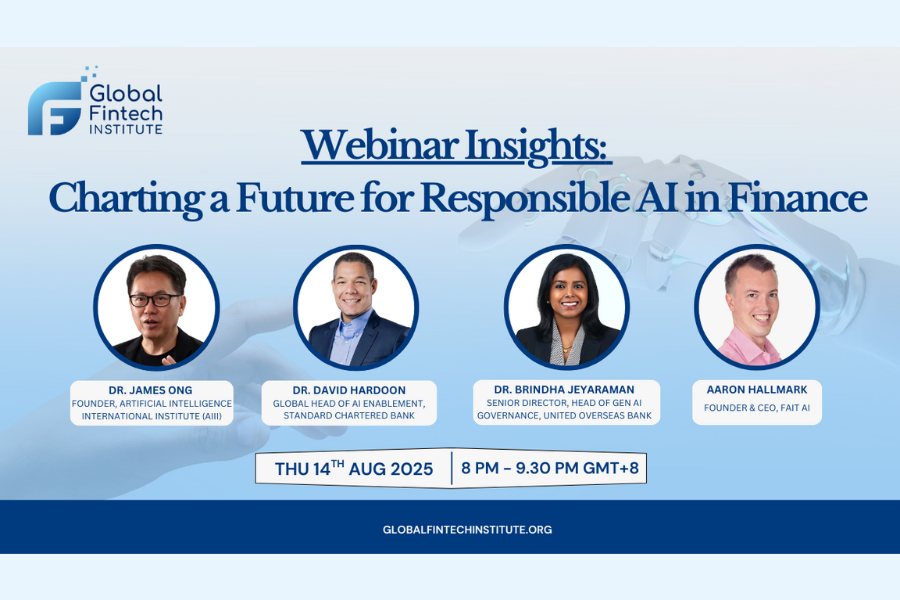
The rapid rise of AI in finance has made responsible governance not just a regulatory concern but a defining challenge for the industry. At our recent panel, Charting a Future for Responsible AI in Finance, speakers from global banks, AI institutes, and fintech firms gathered to explore a critical question: how can financial institutions operationalise responsible AI while sustaining innovation?
The session underscored both urgency and opportunity: embedding governance from the outset, aligning AI initiatives with strategic priorities, and positioning Singapore as a testbed for responsible AI adoption at scale.
Speakers and Moderator
- Dr. James Ong (Moderator) — Founder, Artificial Intelligence International Institute (AIII) | Global Fintech Institute AI Subcommittee Chair
- Dr. David Hardoon — Global Head of AI Enablement, Standard Chartered Bank
- Dr. Brindha Jeyaraman — Senior Director, Head of Gen AI Governance, United Overseas Bank | Global Fintech Institute Industry Fellow
- Aaron Hallmark — Founder & CEO, FAIT AI
Panel Highlights
Responsible AI by design
- Governance must be integrated at every stage of the AI lifecycle, rather than added post-deployment. The panel called for codified testing, monitoring, and contextual risk management as the baseline for responsible use.
From aspiration to practice
- Principles only matter when translated into production. Institutions need continuous monitoring frameworks, probabilistic testing methods, and clarity on workflows — distinguishing deterministic systems from probabilistic AI components.
Strategic focus and ROI
- With many parallel initiatives underway, prioritisation is key. The panel urged firms to align use cases with ROI horizons, consider workforce impacts, and build compounding value over time.
Human augmentation, not replacement
- AI should strengthen human decision-making, particularly in areas requiring empathy and nuanced client engagement. Transparency is also critical to support junior staff development and preserve career pathways.
Industry-wide collaboration
- Shared testing kits, guardrails-as-code, and cross-industry working groups can accelerate adoption and help firms of all sizes benefit from responsible frameworks.
Singapore as a proving ground
- With its scale, coordination, and talent density, Singapore is uniquely positioned to incubate responsible AI practices and export them globally. Sustaining risk appetite will be key to retaining that edge.
Notable Quotes 📌
- “Governance accelerates innovation.”
- “If you’re still asking which AI model is the best, then your governance and architecture is already behind.”
- “Build trust right from the beginning and innovation will follow.”
- “Perfect is the enemy of good; have intent and design deliberately.”
Insights and Takeaways
- Embedding governance early reduces friction and builds trust at scale.
- AI testing must shift toward probabilistic frameworks with thresholds and monitoring.
- Workflow segmentation — deterministic, probabilistic, human-relational — ensures the right technology is applied to the right task.
- Institutions must anticipate workforce evolution, designing systems that support transparency, junior training, and new management models.
- Shared frameworks and artefacts can reduce duplicated effort and raise the baseline for responsible adoption.
Challenges and Debates
- Policy–practice gap: High-level ethics frameworks often fail to translate into explainable, reproducible production systems.
- Innovation vs regulation: Effective governance accelerates adoption, but poorly executed oversight can create drag.
- Fragmented global frameworks: Divergent standards (EU AI Act, NIST RMF, Singapore’s models) complicate compliance.
- Risk appetite: Singapore’s leadership depends on sustaining willingness to experiment.
- Inclusion and ethics: AI in screening and selection raises equity concerns, demanding contextual safeguards and sovereign justification.
Conclusion
The discussion converged on a pragmatic blueprint: design governance into AI from the start, adopt probabilistic testing, segment workflows intelligently, and align initiatives with ROI and workforce development goals.
Collaboration across industry will be essential, and Singapore is well placed to lead as a nation-scale incubator — provided it sustains its risk appetite and translates pilots into adaptable global models.
At the heart of the panel was a reminder that responsible AI in finance must remain human-centric, augmenting people, deepening trust, and advancing responsible innovation.
Disclaimer: This summary reflects the content of the event discussion only. It is not legal advice and does not represent the official opinions of Global Fintech Institute.