Event Overview
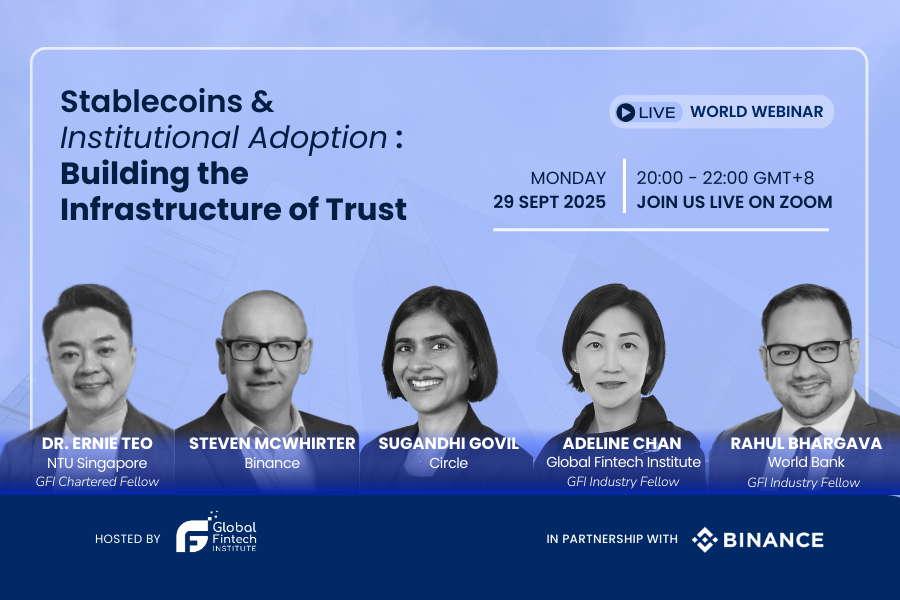
At our recent panel Stablecoins & Institutional Adoption: Building the Infrastructure of Trust, leaders from Circle, The World Bank, Binance, Nanyang Technological University of Singapore and The Global Fintech Institute explored the drivers, challenges, and opportunities shaping the institutional adoption of stablecoins.
The panel highlighted how stablecoins are transforming digital finance by enabling real-time, borderless transactions, while raising key issues around regulatory clarity, interoperability, risk management, and long-term trust.
🎙 Speakers and Moderator
- Dr. Ernie Teo (Moderator) — Program Director & Senior Lecturer, NTU Singapore | GFI Chartered Fellow
- Steven McWhirter — Global Policy Lead, Binance
- Sugandhi Govil — Director Compliance APAC & MLRO, Circle
- Adeline Chan — Vice-Chair, Blockchain Security & Compliance Committee, Global Fintech Institute | GFI Industry Fellow
- Rahul Bhargava — Senior Financial Sector Consultant, World Bank | GFI Industry Fellow | Ambassador – Emerging Payments Association Asia & Currency Research
Panel Highlights
- AI & Agentic Payments — The convergence of AI and stablecoins points to a future where autonomous agents may manage payments, liquidity and treasury operations 24/7.
- Institutional drivers are accelerating adoption — Clear regulation, 24/7 global operations, and efficiencies in settlement are making stablecoins increasingly attractive for institutional portfolios.
- Regulatory Clarity Is Foundational — Institutions will only scale adoption if strong legal classifications, reserve transparency, and harmonised cross-border frameworks are in place.
- Operational and Legal Due Diligence Is Critical — Institutions may apply a due diligence framework like SIRI (Stablecoin design, Issuer governance, Reserve transparency, and Infrastructure security) before allocating capital.
- Innovation and real-world use cases are here — From cross-border remittances to embedded finance, stablecoins are enabling programmable money and hybrid financial products.
- Trust must equal fiat — Reserves, audits, and AML/CFT controls are non-negotiable to ensure institutions treat stablecoins with the same confidence as traditional money.
- Coexistence with CBDCs and Tokenised Deposits is inevitable — Regulated stablecoins, CBDCs, and bank-issued tokens will likely operate side by side, with infrastructure receding as trust and customer value take precedence.
📌 Notable Quotes
- “Money can move at the speed of the internet, 24/7, at a fraction of the cost.”
- "The trust we need in stablecoins must equal the trust we have in fiat.”
- “Fragmentation introduces friction; ultimately, consumers pay the costs.”
- “Compliance teams are not an afterthought — they have the front seat.”
Insights & Takeaways
- Stablecoins are becoming a bridge between traditional finance and digital assets.
- Regulatory clarity and compliance by design are foundational to trust.
- Operational efficiencies are driving new business models in payments and settlements.
- Collaboration between industry and regulators will be essential to harmonise standards and mitigate risks.
- Transparency in reserves and audits builds institutional resilience and confidence.
🗣️ Challenges & Debates
- Global regulatory fragmentation and lack of harmonisation
- Systemic risks from issuer concentration
- Balancing innovation with effective regulation
- Operational hurdles in custody, redemption, and cross-border last-mile delivery
- Gaps in education around stablecoin-enabled business models
Conclusion
Stablecoins are no longer peripheral — they’re moving into the core of institutional finance. Their success depends on trust, transparency, and compliance, alongside regulator-industry collaboration.
The panel made clear that stablecoins are not just a technical innovation, but a test of the industry’s ability to design robust, interoperable systems that advance inclusion, efficiency, and resilience in global finance. This is particularly visible in the APAC region, which is leading global stablecoin adoption, driven by factors like strong regulatory clarity and diverse, real-world use cases.
📌 Disclaimer: This summary reflects the event discussion only. It is not legal advice and does not represent the official views of the Global Fintech Institute or the organisations represented.
🎥 The full webinar recording is exclusive to GFI members.